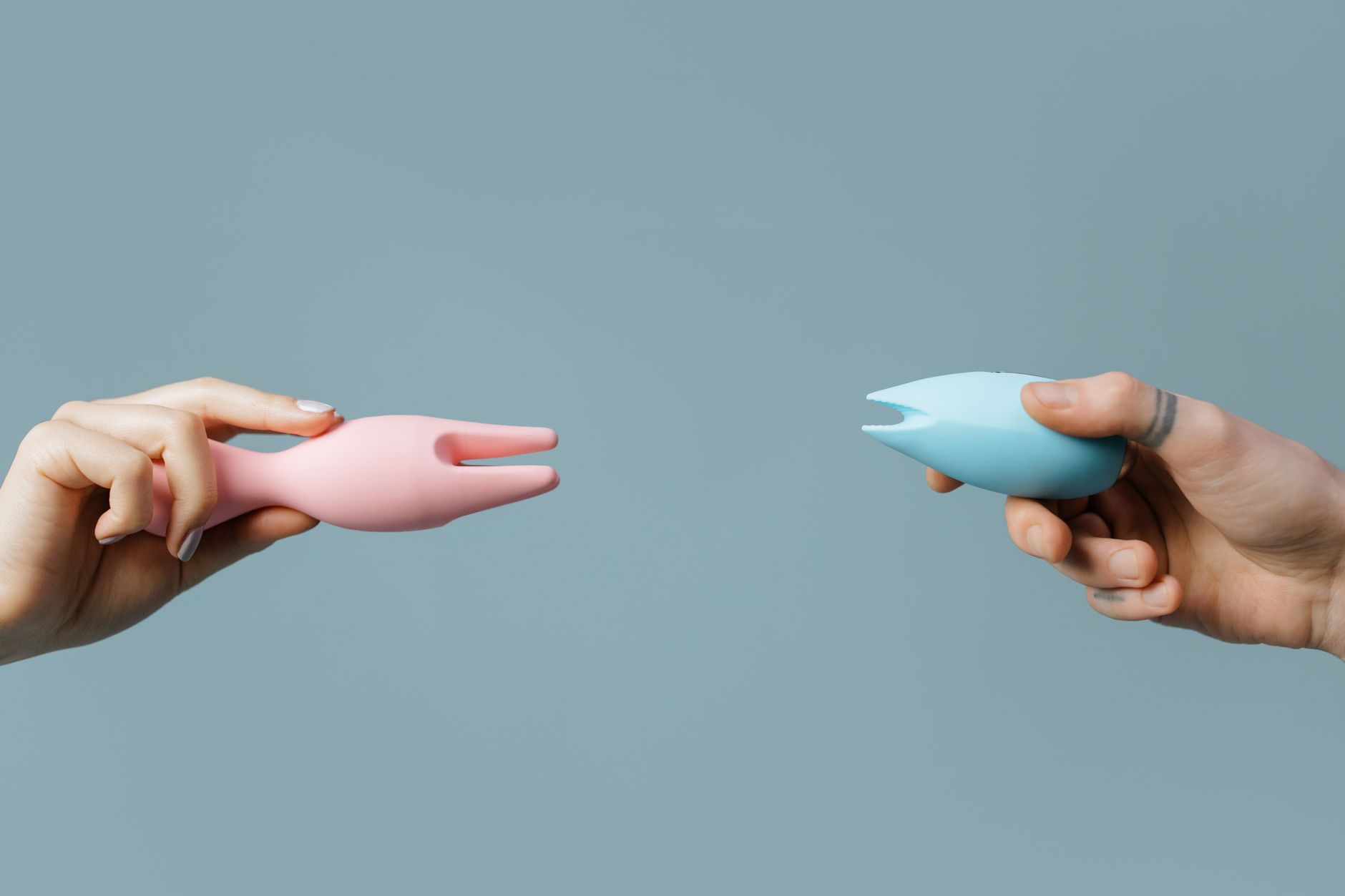
The thing nobody tells you about bringing toys into partnered sex
Here's what I've heard a hundred times in my practice: "I want to try a lemon vibrator with my partner, but it feels weird." Not weird like kinky weird. Weird like standing naked in a toy store fluorescent lighting weird. Weird like admitting you want something you're not sure they're going to understand. Weird like vulnerable.
The good news is that awkwardness is not a sign you shouldn't do it. It's normal. Almost everyone feels it. And it passes quickly once you actually start.
Why the resistance shows up in the first place
Bringing a lemon clitoral vibrator into partnered sex can trigger a bunch of old narratives at once. Maybe you're worried your partner will feel replaced or inadequate. Maybe you've internalized the idea that wanting external stimulation means something's wrong with you or them. Maybe you're afraid of being judged for wanting to feel good in a way that requires technology. Maybe you just don't know how to talk about it without it sounding clinical.
These worries make sense. But here's what I know from working with couples for decades: the awkwardness is almost always worse in your head than it is in reality. Partners who love you want you to feel good. They really do. And introducing a lemon vibrator is not a referendum on your relationship. It's an expansion of it.
The conversation you don't need to have
You don't need a serious state-of-the-union address about this. You don't need to schedule a talk, sit them down, and explain your entire sexual history and why you think a lemon sucker would improve things. That framing makes it heavier than it is.
Instead, treat it like you'd treat any other suggestion about what you both might enjoy. "I've been reading about lemon vibrators and I'm curious to try one together" is enough. If they ask questions, answer them. If they don't, move on. The magic is in the casualness.
If your partner tends to shut down around sex talk generally, that's a different conversation (and worth working through separately). But most people respond well to lighthearted, direct suggestions about pleasure. "Want to try this?" beats months of anxious silence.
How to actually introduce it without drama
The least awkward entry point is usually during foreplay, not as a main event. Have the lemon vibrator already in the room (your nightstand, under the bed, wherever). When things are heating up, you can simply say: "Want to try this?" Hand it over. Let your partner hold it, play with it, figure out the settings. Remove yourself from the equation for a moment. This takes the pressure off both of you.
Alternatively, you can use it on yourself first while your partner watches. This is actually my preferred approach because it does three things at once: it shows them what it does, it gives them permission to enjoy watching, and it keeps the focus on your pleasure rather than on their performance or their insecurity.
Most partners find watching their partner use a lemon vibrator genuinely hot. You might be surprised.
The settings question
Lem vibrators work best on lower settings when you're with a partner, at least at first. Patterns 1 through 4 are your friend. Higher settings can make you tense up or make it harder to stay present with another person. You want stimulation that feels good but doesn't require all your cognitive load to process. Save the intensity exploration for solo sessions, and bring the softer, more playful stuff to partnered time.
Let your partner try different patterns too, if you're comfortable with it. Some couples love the shared control aspect. Others prefer to keep it as a "you adjust it while they touch you" situation. Neither is wrong.
What to do if your partner gets weird about it
Okay. So you suggest it and they respond with defensiveness, jealousy, or dismissal. "I thought I was enough for you." Or: "That feels wrong to me." Or they just go silent.
First: that reaction tells you something useful, but it doesn't mean you can't move forward. It means there's something underneath the surface that deserves attention. It might be genuine discomfort with sex toys. It might be insecurity. It might be past trauma. It might be cultural or religious conditioning. It might be that they're just surprised and need time to sit with the idea.
None of these things are dealbreakers for exploring together. But they do require you to slow down and understand what's actually driving the resistance. Ask: "What specifically feels uncomfortable about this?" Listen without defending yourself or the lemon vibrator. Then share what you actually want: "I want to feel more sensation during sex. I want us to try something that might help. I want you to be part of that."
If your partner remains inflexible after a real conversation, that's worth addressing with a couples therapist. Not because you're doing anything wrong, but because the inability to talk about and explore pleasure together is a broader intimacy issue that's worth unpacking.
The logistics of using it together
Physically, lemon vibrators work well for partnered sex in a few specific positions. Woman on top gives you (and your partner) access to the controls and the toy. Missionary with the vibrator between your bodies works if you're comfortable with that pressure. Side-by-side lets you both relax and focus on sensation.
What doesn't work as well: positions where you can't easily reach your clitoris. Deep penetration positions where the vibrator would be in the way. Anything that requires you to be tensed up or contorted.
Start with whatever position feels most stable and connected. You can get creative later. Right now, the goal is just for both of you to get comfortable with the vibrator being present.
Why the awkwardness is actually a good sign
The fact that you're feeling awkward means you care about this person and you care about doing it right. That's the opposite of a red flag. That's an indicator that you're approaching it with respect and thoughtfulness.
Most couples find that after the first time, the awkwardness evaporates. You've done the thing you were nervous about. It was fine. In fact, it felt good. Next time, there's no mystery. It's just part of your toolkit.
When to check in after
After you've tried it together, give it a day or two before having any kind of debrief. Not a heavy one. Just: "Did you like that?" or "How did that feel?" You're not looking for a detailed analysis. You're just making space for them to share their actual experience without feeling like they have to perform enthusiasm they don't feel.
Most people say it felt good. Some say they want to try different settings or positions next time. A few might say they want to stick with solo exploration for now, and that's okay too. The goal is information, not pressure.
The bigger picture
Bringing a lemon clitoral vibrator into partnered sex is not about fixing anything. Your partner is not insufficient. You're not unfulfilled because something is wrong with your relationship. You're simply exploring what feels good, together. That's not awkward. That's intimate.
People also ask
Will my partner feel threatened if I use a lemon vibrator during partnered sex?
Most won't. Partners who are secure and who care about your pleasure actually find it exciting to see you feel good. If your specific partner does feel threatened, that's worth a conversation with them about where that's coming from. Often the worry is worse than the reality. Many couples find that using a lemon clitoral vibrator when pleasure feels disconnected from your partner actually strengthens their connection by taking pressure off both of them to "perform."
How do I bring it up without sounding like I'm criticizing their performance?
Frame it as an addition, not a replacement. "I want to try this together" is different from "I need this because something's missing." You're not critiquing them. You're expanding the menu. Most partners get that distinction immediately once you say it out loud.
Is it okay to use a lemon vibrator if my partner has a longer refractory period?
Absolutely. In fact, this can be really helpful. While they're recovering, you can use the lemon vibrator on yourself, which means more pleasure for you and takes pressure off them to immediately be ready for round two. A lot of couples find this actually improves their sexual rhythm. If this is your situation, you might find our guide on mismatched refractory periods useful too.
What if we have different comfort levels with toys?
Start slow with your partner's comfort level, not yours. If they're hesitant, introduce it more gently. Let them hold it, play with it, figure out what it does on their own timeline. You're not trying to convince them or prove anything. You're just offering an option. Over time, comfort usually builds.
Can I use a lemon vibrator if we're rebuilding intimacy after conflict?
Sometimes yes, sometimes not yet. If you're in the middle of processing hurt or rebuilding trust, adding a new element might feel too much. But if you've worked through the conflict and you're both interested in reconnecting physically, introducing something playful and low-pressure can actually help. It signals that you're moving forward together. You might also explore how to rebuild intimacy after relationship conflict with professional support.
How do I know if my partner actually wants to use a lemon vibrator with me?
You ask them. Directly. "Would you be open to trying this together?" If they say yes, great. If they say no or not right now, accept that without pressure. You can ask again in six months. You can explore solo in the meantime. But the only way to know is to create space for an honest answer.
The takeaway
Using a lemon vibrator with your partner doesn't require perfection, a perfectly timed conversation, or months of psychological preparation. It requires you to be honest about what you want, to invite your partner to be part of that, and to accept whatever their actual response is without trying to control it. Everything after that is just exploration. And exploration, by definition, means not knowing exactly where it's going. That's the whole point.